The Ultimate Guide to Industrial Sorbents: Choosing the Right Absorbents for Facility Safety and Compliance
In any manufacturing facility, automotive shop, warehouse, or processing plant, liquid leaks, drips, and spills are an inevitable part of daily operations. Whether it’s a slow-dribbling hydraulic line or a sudden 55-gallon drum tip, having a clear spill control strategy—and the right sorbent materials on hand—is critical for workplace safety, regulatory compliance, and operational efficiency.
This guide breaks down how industrial sorbents work, the primary types available, and how to select the right absorbent materials to keep your facility clean, dry, and compliant.
Understanding Industrial Sorbents
Industrial sorbents are specialized materials designed to rapidly attract, absorb, and contain liquids. They are typically constructed from synthetic polymers like meltblown polypropylene or natural organic materials. By converting free-flowing liquid spills into manageable solids, sorbents prevent fluids from spreading across shop floors, entering storm drains, or causing hazardous slip-and-fall incidents.
When evaluating sorbent options for your facility, three core factors dictate performance:
-
Chemical Compatibility: Ensuring the sorbent material won't react dangerously with the absorbed fluid.
-
Absorbent Capacity & Weight: Choosing between light, medium, and heavyweight constructions based on spill volume.
-
Material Construction: Selecting laminated, bonded, or fine-fiber covers depending on foot-traffic levels and durability requirements.
The Three Main Types of Industrial Sorbents
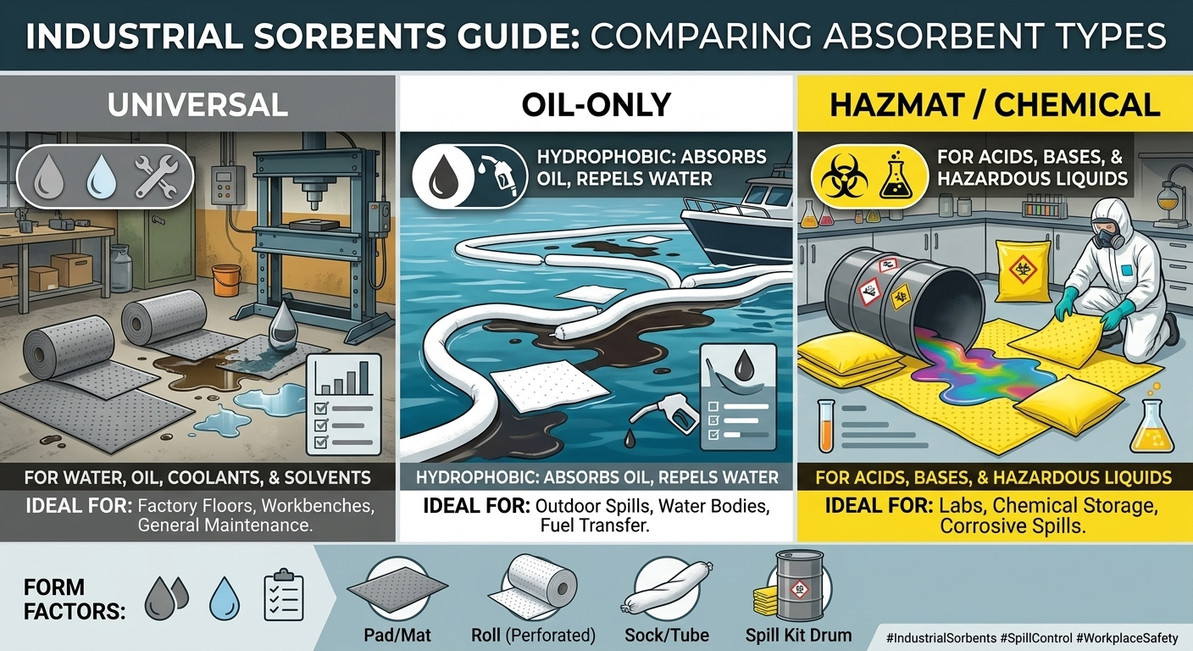
Sorbents are color-coded across the industry to help workers quickly identify and deploy the correct material during a spill emergency:
+-------------------+--------------+-----------------------------------------------------+
| Sorbent Category  | Color Code   | Ideal Liquids & Applications                        |
+-------------------+--------------+-----------------------------------------------------+
| Universal         | Gray         | Water, oils, coolants, solvents, non-aggressive fluid|
| Oil-Only          | White        | Hydrocarbons, fuel, oil (repels water, floats)      |
| HazMat / Chemical | Yellow / Pink| Aggressive acids, bases, unknown chemical spills   |
+-------------------+--------------+-----------------------------------------------------+
1. Universal Sorbents (Gray)
Universal absorbents are the workhorses of general facility maintenance. Made to soak up both water-based and oil-based fluids, gray universal sorbents are ideal for routine leaks under gearboxes, workbench wipedowns, and general aisle protection.
2. Oil-Only Sorbents (White)
Oil-only sorbents are hydrophobic, meaning they selectively absorb petroleum-based fluids while completely repelling water. Because they float on water even when fully saturated, white oil-only pads and booms are essential for outdoor spill kits, marine applications, and oil-water separators.
3. HazMat & Chemical Sorbents (Yellow or Pink)
Designed for hazardous environments, HazMat sorbents are chemically inert and treated to handle aggressive fluids like concentrated acids, caustics, and unknown chemical leaks without degrading.
Form Factors: Choosing the Right Sorbent Format
Industrial sorbents come in several physical formats engineered for specific containment scenarios:
-
Pads & Mats: Pre-cut sheets ideal for wiping down tools, lining workbenches, or catching localized drips under machinery.
-
Continuous Rolls: Perforated rolls that allow workers to tear off exact lengths—ideal for lining long walkways or creating custom drip trays.
-
Socks & Tubes: Flexible cylindrical tubes designed to surround machine bases or form a perimeter dike around active spills.
-
Pillows: High-capacity sorbents designed to catch high-volume leaks under dripping pipes or saturated machinery.
-
Spill Kits: Pre-packaged drums, caddies, or bags containing a mix of pads, socks, disposal bags, and PPE for rapid emergency response.
Key Best Practices for Facility Spill Management
-
Place Sorbents Near Risk Points: Store spill response materials within immediate reach of liquid storage areas, fluid transfer stations, and heavy machinery.
-
Size Your Spill Kits Appropriately: Ensure each department has sufficient absorbents to handle the maximum potential volume of its largest single container.
-
Control Material Waste: Utilize perforated sorbent rolls so employees tear off only the exact amount needed for small cleanups, reducing waste disposal weight.
Ready to Upgrade Your Facility Spill Control?
Equipping your facility with the right universal and specialized sorbents is one of the easiest ways to prevent costly workplace injuries and maintain a clean, professional environment. Explore our complete selection of industrial sorbent pads, rolls, and spill kits to keep your shop floor safe and compliant.
Recent Posts
-

Why Electricians and Line Workers Are Switching to Stanco™ FRC1512 Memory Stretch Jeans
For electricians, utility technicians, and linemen, mobility isn't just about comfort—it's a fundame …16th Oct 2026 -
Understanding NFPA 70E & CAT 2 Compliance: A Safety Director’s Guide to Daily FR Workwear
For safety managers, EHS directors, and facility leaders, outfitting a workforce in flame-resistant …13th Oct 2026 -

Lightweight Defense, Heavy-Duty Performance: Why the Forge FR MFRP-06 Ripstop Pants Belong on Your Jobsite
When working long shifts in warm weather, high-humidity environments, or physically demanding jobsit …6th Oct 2026