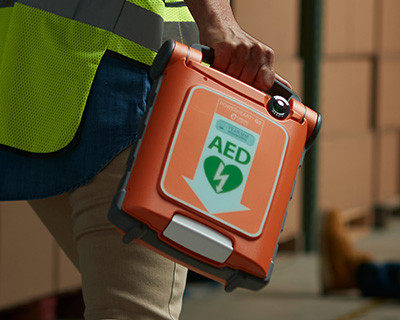
Dual-Language AEDs: Why Bilingual First-Aid Equipment Matters for Workplace Safety
In a medical emergency, every second spent hesitating can impact a victim's chances of survival. Sudden cardiac arrest (SCA) requires immediate, decisive action—yet one of the most overlooked barriers during a rescue is a language gap. If a responder cannot instantly understand an Automated External Defibrillator’s (AED) voice instructions, valuable time is lost.
Deploying dual-language AEDs, such as the Cardiac Science Powerheart G5, ensures that a wider range of employees and visitors can step up as life-saving responders without delay.
The Power of One-Touch Language Switching
During high-stress events, forcing a responder to navigate complex menus or reboot a device to change the operating language adds unnecessary risk. Purpose-built bilingual AEDs solve this issue with instant accessibility:
-
Seamless Toggling: With a single button press, responders can switch the device's voice and text prompts between primary and secondary languages (such as English and Spanish) at any point during a rescue without interrupting device performance.
-
Equal Access for Diverse Teams: Facilities with multi-lingual workforces—from manufacturing plants and distribution centers to commercial offices—can empower every employee to act confidently.
-
Clear User-Paced Prompts: Adaptive voice prompts (like Cardiac Science's RescueCoach™ system) pace the instructions to match the user's progress, guiding them through pad placement and CPR steps in their primary language.
Key Features to Look for in Commercial AEDs
When selecting emergency defibrillators for a commercial facility or public building, dual-language capabilities are just one part of a comprehensive safety strategy. Look for devices that offer:
-
Integrated Real-Time CPR Feedback: Sensors on the defibrillation pads measure compression depth and rate, providing real-time audio and visual correction (e.g., "Push Harder").
-
Non-Polarized Pads: Defibrillation pads that can be placed in either position on the chest reduce confusion and speed up application time.
-
Rugged Environmental Ratings: Industrial spaces require units with high ingress protection (such as an IP55 rating) to guard against dust, water, and rough handling.
Strengthen Your Facility’s Readiness
Upgrading your safety equipment to include bilingual defibrillators removes critical communication barriers when cardiac emergencies occur. Pairing these units with high-visibility wall cabinets, backup pad sets, and trained staff creates a truly responsive safety program.
Is your facility equipped for a bilingual emergency response? Contact our safety product specialists today to explore our full line of commercial AEDs, wall enclosures, and compliance management solutions.
Recent Posts
-
Dual-Language AEDs: Why Bilingual First-Aid Equipment Matters for Workplace Safety
In a medical emergency, every second spent hesitating can impact a victim's chances of survival. Sud …9th Sep 2026 -
Over 356,000 Out-of-Hospital Cardiac Arrests Occur Annually: Is Your Facility Prepared?
Emergencies don’t wait, and neither should your facility's safety program. According to CDC data, ov …8th Sep 2026 -
National Preparedness Month: Is Your Facility Ready for a Cardiac Emergency?
September marks National Preparedness Month, making it the ideal time for business owners, safety di …4th Sep 2026