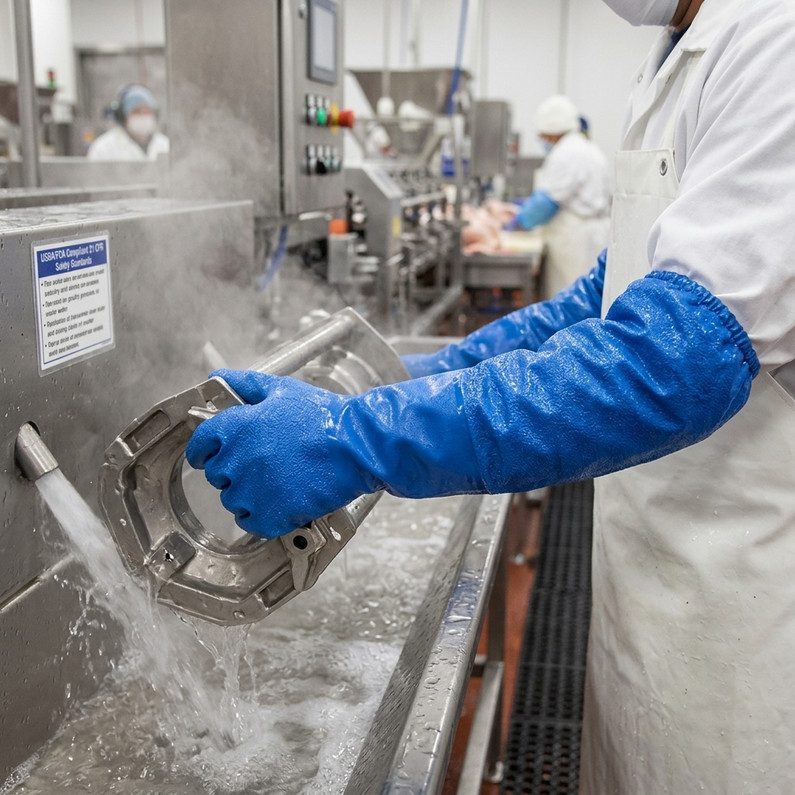
How to Select the Right Extended-Sleeve Glove for Food Processing & Harsh Chemical Washdowns
In commercial food processing, chemical mixing, and cold storage facilities, standard wrist- or forearm-length safety gloves simply don't offer enough protection. When workers handle deep-tank liquid immersion, high-pressure equipment washdowns, or harsh caustics, fluid splashes above the elbow create immediate safety and compliance hazards.
Selecting the right extended-length protective glove requires balancing fluid barrier coverage, thermal insulation, chemical resistance, and food safety compliance.
Here is a breakdown of what safety managers and facility operators should look for when sourcing heavy-duty, full-arm hand protection.
1. Full-Arm Coverage & Splash Protection Standard chemical gloves typically range from 11 to 14 inches in length, leaving the upper forearm and elbow exposed. For deep-tank operations or overhead washdowns, look for gloves with an extended length—such as 26 inches—that fuse a standard hand section with a dedicated extended sleeve. An elastic cuff at the top of the sleeve ensures the glove stays securely in place without sliding down during active movement.
2. Extreme Temperature Resistance Food processing and industrial sanitation environments often expose workers to thermal extremes, from freezer storage and ice handling to hot liquid sanitation lines. A high-performance insulated glove should provide a reliable operating range—ideally protecting against cold down to -10°F (-23°C) and dry/liquid heat up to 300°F (149°C)—without stiffening, cracking, or losing flexibility.
3. USDA & FDA 21 CFR Compliance When gloves come into direct or indirect contact with food products, raw meats, or processing surfaces, regulatory compliance is non-negotiable. Ensure your selected gloves comply with FDA 21 CFR regulations for indirect food contact. Synthetic nitrile construction is particularly well-suited for meat and poultry packing, as it offers exceptional resistance to animal fats, oils, and harsh cleaning caustics that degrade standard latex or vinyl alternatives.
4. Interlock Lining & Sanitized Coatings Heavy-duty gloves are only effective if employees can wear them comfortably through full shifts. An internal interlock cotton knit liner provides key benefits:
-
Mechanical Strength: Increases tear, puncture, and abrasion resistance.
-
Thermal Comfort: Cushions the hand and absorbs sweat during extended wear.
-
Sanitization: Built-in anti-bacterial and anti-mildew treatments help prevent odor buildup and bacterial growth inside the glove between uses.
5. Secure Grip in Wet & Greasy Conditions Handling smooth food products, wet metal parts, or chemical drums requires a tactile, slip-resistant surface. Look for gloves with a heavy-duty rough grip coating on the palm and fingers to maintain high dexterity and prevent accidental drops, even when submerged in greasy or oily liquids.
Practical Protection: The Assurance® Nitri-Knit™ NK803ESIN
If your facility requires a proven solution that ticks every box, the Assurance® Nitri-Knit™ NK803ESIN 26" Extended Sleeve Insulated Nitrile Glove is built specifically for these demanding conditions. Featuring a 15-inch extended sleeve, a temperature rating from -10°F to 300°F, FDA 21 CFR food contact compliance, and a heavy rough-grip finish, it provides complete hand-to-elbow protection for your workforce.
Recent Posts
-
Protection Meets Practicality: Forge FR P-MFRP-5 Brown Canvas Work Pants
When working in environments with flame and arc hazards, having safety gear that is both certified a …21st Oct 2026 -
Stanco FRC1512 vs. Forge FR MFRJ-104: Which FR Stretch Jeans Belong on Your Crew?
Choosing the right flame-resistant (FR) work jeans for your crew comes down to balancing arc flash p …21st Oct 2026 -

Why Electricians and Line Workers Are Switching to Stanco™ FRC1512 Memory Stretch Jeans
For electricians, utility technicians, and linemen, mobility isn't just about comfort—it's a fundame …16th Oct 2026