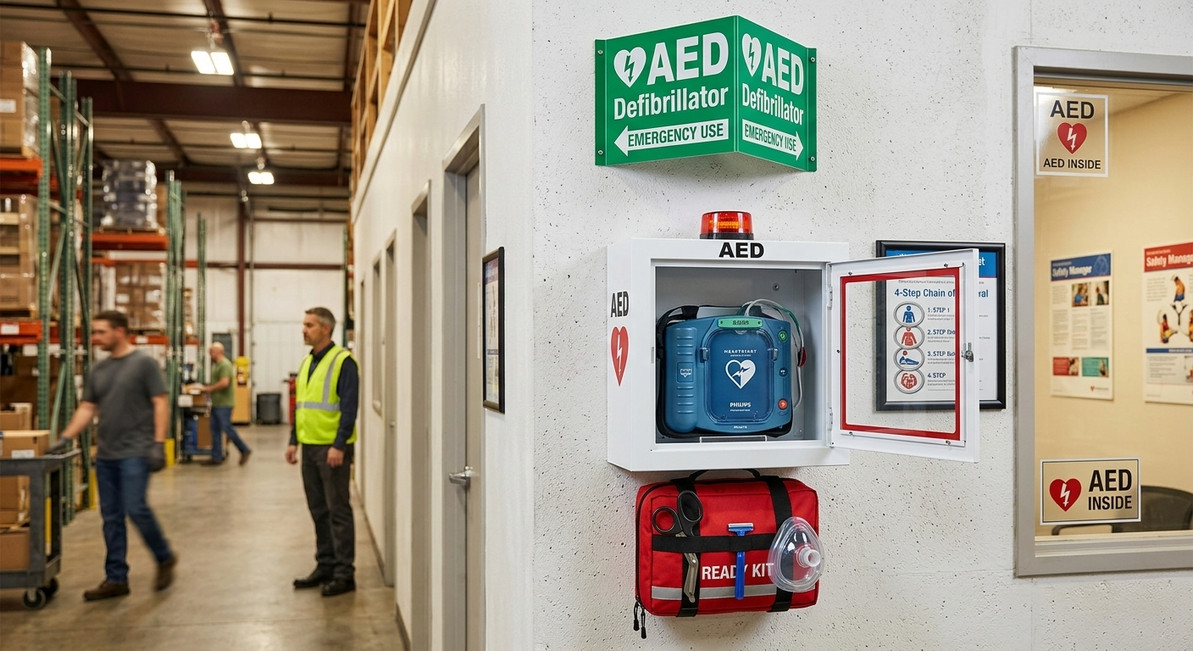
The Hidden Danger in Your Safety Cabinet: Why Expired AED Pads Fail When You Need Them Most
When facility managers and safety officers audit their workplace emergency equipment, automated external defibrillators (AEDs) are usually at the top of the list. The green readiness indicator light is flashing, the unit looks pristine, and everyone assumes the business is fully protected.
However, behind the clear door of your wall cabinet sits a hidden vulnerability: expired defibrillator pads.
Unlike batteries—which typically give loud, chirping warning tones as they near end-of-life—electrode pads expire quietly in their sealed foil packages. Understanding why pads expire, what actually happens to them over time, and how to stay compliant could save a life in your facility.
The Science Behind the Expiration Date: What Happens to the Gel?
AED pads do far more than simply deliver electrical current; they are the sole diagnostic conduit between the patient’s body and the AED's internal software.
Underneath the plastic backing of every electrode pad—whether it’s a Philips SMART Pads Cartridge (M5071A), a ZOLL CPR D Padz, or Cardiac Science Intellisense pads—lies a thick layer of water-based conductive hydrogel. This hydrogel serves two critical non-negotiable functions:
-
Conductivity: It creates a uniform, low-resistance electrical bridge across the skin so the AED can read cardiac rhythms accurately and pass high-voltage therapy safely.
-
Adhesion: It sticks firmly to the chest so pads do not lift or peel during high-impact CPR chest compressions.
Over a typical 2-to-5-year shelf life, the water in that hydrogel slowly evaporates—even through sealed foil packaging. As the gel dries, two major failure modes occur during a rescue:
-
Failure to Analyze Rhythms: If the gel is dried out, the AED's pre-shock impedance check will detect high resistance. The machine may repeatedly prompt you to "check pads" or "apply pads firmly," halting the rescue process.
-
Severe Skin Burns or Ineffective Shock: Dry spots create concentrated pockets of electrical resistance. Instead of dispersing energy evenly across the chest, the shock concentrates in tiny areas, potentially causing thermal skin burns or failing to convert the lethal heart rhythm.
How Environmental Factors Accelerate Pad Aging
Storage conditions play a massive role in pad longevity. Pads mounted near unconditioned loading docks, stored in service vehicles, or kept near exterior doors experience high temperature swings that break down adhesive seals much faster. Extreme heat bakes the hydrogel, while extreme cold makes the adhesive brittle and unresponsive.
3 Steps to Keep Your Facility Rescue-Ready
Maintaining 100% compliance across your workplace AED program requires simple, routine maintenance habits:
-
Inspect the Physical Expiration Date Monthly: Do not rely solely on the AED’s main status light. Open the cabinet door, inspect the foil pack, and check the hourglass symbol or "Use By" date printed on the front.
-
Keep an On-Site Spare Set: Always keep a second, sealed pad cartridge inside your carry case or cabinet. If a patient has heavy chest hair or diaphoresis (sweating), the first set may be used to clear the chest before placing the second set.
-
Pre-Order Replacements 60 Days Early: Lead times for medical supplies fluctuate. Ordering replacement pads two months before the posted expiration date ensures zero gap in your facility's safety coverage.
Keep Your Workplace Fully Protected
Don't let a dried-out $60 pad compromise a multi-thousand-dollar safety investment. Audit your cabinets today to ensure all adult and pediatric pad cartridges are well within their service dates.
Need replacement pads or batteries for your Philips, ZOLL, or Cardiac Science AEDs? Browse our complete catalog of OEM replacement pads and long-life batteries, or contact our support team today for assistance!
Recent Posts
-

Lightweight Defense, Heavy-Duty Performance: Why the Forge FR MFRP-06 Ripstop Pants Belong on Your Jobsite
When working long shifts in warm weather, high-humidity environments, or physically demanding jobsit …6th Oct 2026 -
Comfort Meets Compliance: Why the Stanco™ FRC1512 Renegade FR Jeans Are Changing Industrial Workwear
For decades, wearing flame-resistant (FR) workwear meant making a compromise: safety and protection …2nd Oct 2026 -

Choosing the Right Heavy-Duty Hand Cleaner for Your Shop: Solvents, Scrubbers, and Skin Health
Whether you run an auto repair shop, manage a manufacturing floor, or oversee a fleet maintenance fa …28th Sep 2026