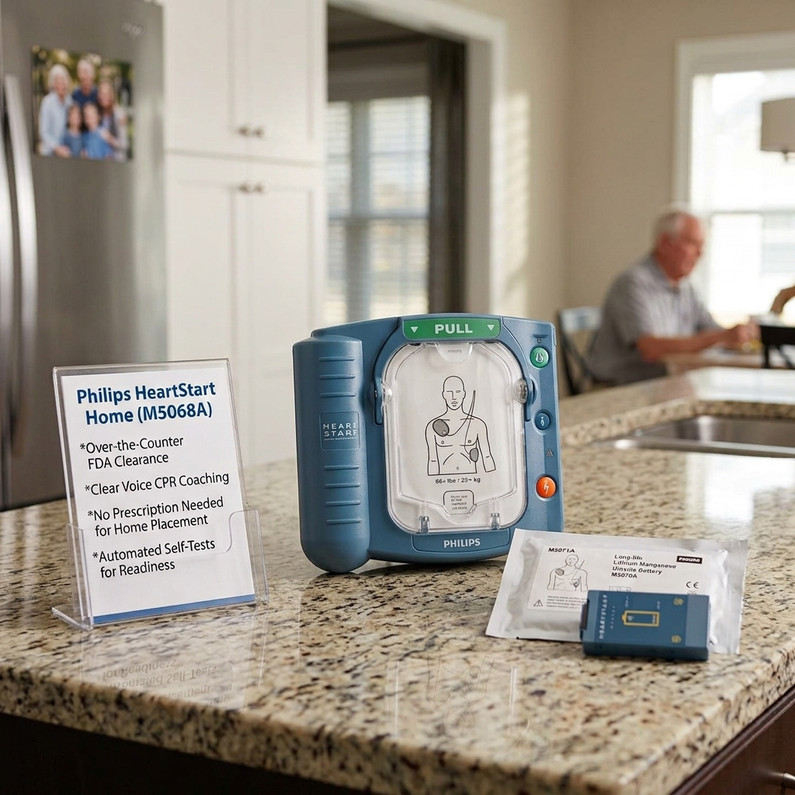
Is Your Family Prepared? Why Modern Defibrillators Belong in the Home
When we think of Automated External Defibrillators (AEDs), most of us picture them mounted on airport walls, inside corporate offices, or hanging in school gymnasiums. But medical statistics paint a very different picture of where cardiac emergencies actually occur.
According to American Heart Association data, over 350,000 out-of-hospital cardiac arrests (OHCA) occur in the United States each year, and roughly 71% of those events happen at home.
When a family member or guest experiences sudden cardiac arrest (SCA), waiting for emergency responders is rarely enough. Brain tissue begins to suffer damage within 4 to 6 minutes without circulation, while average EMS response times often extend past 8 minutes. Having a residential AED on hand bridges that critical gap.
Overcoming Common Misconceptions About Home AEDs
Despite how vital home emergency preparedness is, many homeowners hesitate to invest in a defibrillator due to a few common myths:
-
Myth 1: You Need a Doctor's Prescription.
Fact: The FDA has approved specific models—such as the Philips HeartStart Home Defibrillator (M5068A)—for over-the-counter (OTC) home purchase. You do not need a medical license or prescription to buy or keep one in your house.
-
Myth 2: "What If I Accidentally Shock Someone?"
Fact: Modern residential AEDs are completely fail-safe. The device analyzes the patient's heart rhythm using advanced algorithms and will only deliver a shock if a shockable rhythm (such as Ventricular Fibrillation) is detected. You cannot shock someone who does not need it.
-
Myth 3: You Need Advanced Medical Training.
Fact: Home AEDs are engineered specifically for untrained laypeople. Clear, adaptive voice prompts walk you through every step—from pulling the handle and applying pads to pacing your CPR chest compressions.
Who Benefits Most From a Home Defibrillator?
While cardiac arrest can strike anyone without warning, a residential AED is an especially critical addition for households that fit these profiles:
-
High-Risk Individuals or Seniors: Homes with family members managing underlying heart conditions, previous cardiac events, or advanced age.
-
Rural and Remote Properties: Residences located further away from emergency medical infrastructure where EMS transport times are extended.
-
Homes with Active Lifestyles or Pools: Workouts, swimming, and strenuous physical activities naturally increase the risk of unexpected acute events.
Key Features to Look For in a Residential AED
If you are evaluating defibrillators for your household, prioritize these features to ensure hassle-free operation:
-
Automated Self-Testing: Look for units that perform daily, weekly, and monthly internal checks on battery life and pad readiness so you know the device is active without manual maintenance.
-
Integrated CPR Guidance: On-demand audio and visual cues guide rescuers through proper compression speed and depth during chest compressions.
-
Pediatric Compatibility: Ensure the unit supports infant/child pad cartridges (such as the Philips M5072A) if you have young children or grandchildren in the home.
Protect Your Loved Ones with Residential Preparedness
Adding a defibrillator to your home first-aid setup delivers unmatched peace of mind. By combining early CPR with an immediate AED response, survival chances can double or even triple.
Ready to safeguard your residence? Explore our over-the-counter residential AED options, replacement pads, and home safety accessories today, or reach out to our team to find the right unit for your household!
Recent Posts
-
Protection Meets Practicality: Forge FR P-MFRP-5 Brown Canvas Work Pants
When working in environments with flame and arc hazards, having safety gear that is both certified a …21st Oct 2026 -
Stanco FRC1512 vs. Forge FR MFRJ-104: Which FR Stretch Jeans Belong on Your Crew?
Choosing the right flame-resistant (FR) work jeans for your crew comes down to balancing arc flash p …21st Oct 2026 -
Why Electricians and Line Workers Are Switching to Stanco™ FRC1512 Memory Stretch Jeans
For electricians, utility technicians, and linemen, mobility isn't just about comfort—it's a fundame …16th Oct 2026