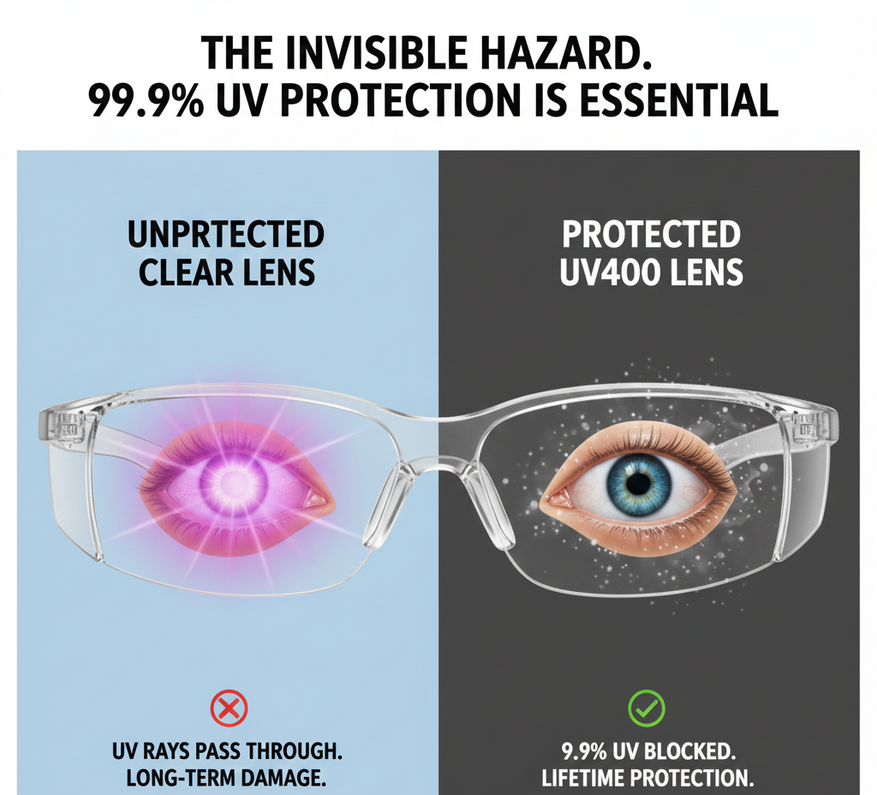
The Invisible Hazard: Why Your Clear Safety Glasses Still Need 99.9% UV Protection
When most people think of eye protection from the sun, they think of dark sunglasses. Naturally, a clear lens seems to offer no defense against UV rays. This assumption is dangerously false and a major hazard in the workplace.
The truth is that UV radiation is invisible, and clear safety glasses without a proper UV coating are simply magnifying glasses that leave your eyes exposed to long-term damage. For every worker—indoors or outdoors—UV protection is non-negotiable.
1. UV Exposure is Not Limited to Direct Sunlight
UV rays (both UVA and UVB) don't just hit you from the sun; they bounce off of surfaces like concrete, water, metal, and snow.
-
Construction Sites: Reflections off aluminum siding, tools, and metal decking create high exposure hazards.
-
Indoor Work: UV light can still penetrate windows. Furthermore, many industrial light sources, like specialized mercury vapor lamps or curing lights, emit harmful UV radiation.
If your clear lenses lack proper UV protection, your eyes are vulnerable all day long, even in the shade.
2. The Long-Term Danger of Unprotected UV Exposure
Unlike the immediate impact of a flying shard of metal, UV damage accumulates silently over years, leading to serious, irreversible conditions:
-
Cataracts: UV exposure accelerates the clouding of the eye's natural lens, which is the leading cause of blindness worldwide.
-
Macular Degeneration (AMD): High-energy UV light is a major contributing factor to AMD, which causes irreversible loss of central vision.
-
Photokeratitis ("Eye Sunburn"): Short-term, intense UV exposure (like from welding flash or reflected snow) can cause a painful "sunburn" of the cornea, leading to temporary vision loss, tearing, and pain.
3. The Clear Difference: Polycarbonate and Coatings
The good news is that achieving 99.9% UV protection doesn't require a dark tint. The protection comes from the material and the coating:
-
Polycarbonate Material: Almost all modern safety lenses are made of polycarbonate, which inherently blocks a significant amount of UV radiation.
-
Specialized Coatings: The best safety glasses feature a UV-absorbing coating that ensures they block 99.9% of UVA and UVB rays up to 400nm (often labeled UV400). This coating is applied regardless of whether the lens is clear, gray, or indoor/outdoor blue.
What to Look For:
When purchasing any safety glasses, always confirm the lens specification includes:
-
99.9% UV Protection (or UV400)
-
Compliance with ANSI Z87.1-2020 (which mandates UV protection for all tinted lenses and strongly recommends it for clear)
The Bottom Line: Never assume a clear lens is safe from the sun's rays. Whether you choose the PIP Recon™ Clear FogLess® 3Sixty™ or a gray-tinted option, that 99.9% UV protection rating is the invisible shield that protects your workers' vision for life.
Recent Posts
-
Protection Meets Practicality: Forge FR P-MFRP-5 Brown Canvas Work Pants
When working in environments with flame and arc hazards, having safety gear that is both certified a …21st Oct 2026 -
Stanco FRC1512 vs. Forge FR MFRJ-104: Which FR Stretch Jeans Belong on Your Crew?
Choosing the right flame-resistant (FR) work jeans for your crew comes down to balancing arc flash p …21st Oct 2026 -
Why Electricians and Line Workers Are Switching to Stanco™ FRC1512 Memory Stretch Jeans
For electricians, utility technicians, and linemen, mobility isn't just about comfort—it's a fundame …16th Oct 2026