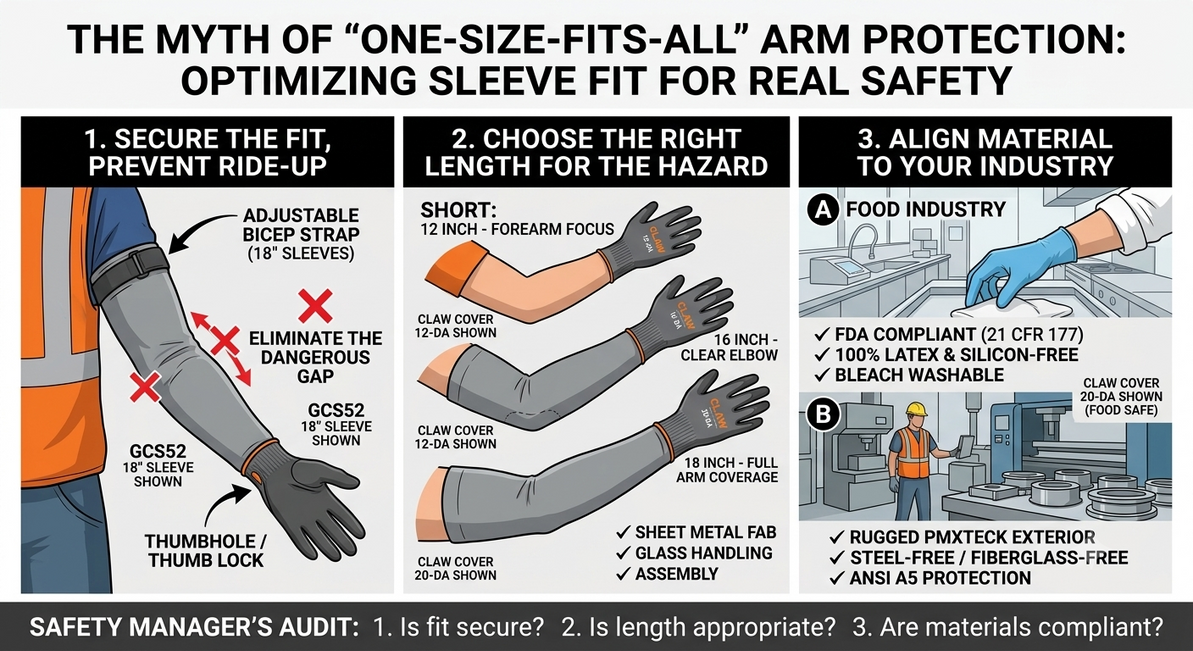
Why True Arm Protection Means Ditching the "One-Size-Fits-All" Mindset
When it comes to industrial safety, your hands usually get the spotlight. We talk endlessly about choosing the right work gloves, matching cut levels, and ensuring proper grip. But all too often, arm protection is treated as an afterthought—a generic, "one-size-fits-all" tube of fabric tossed into a locker.
The truth? In high-risk environments like sheet metal fabrication, glass handling, and food processing, inadequate arm protection is a fast track to severe lacerations and costly OSHA compliance issues.
True safety isn't just about fabric strength; it’s about a tailored fit. Here is a breakdown of why matching the exact sleeve style to the job is the only way to truly protect your crew.
1. Match the Length to the Hazard Profile
A sleeve that is too short leaves vital skin exposed, while a sleeve that is too long bunches up, limits mobility, and creates caught-in hazards.
-
12-Inch Sleeves: Ideal for wrist-to-forearm protection where workers are dealing with precise, localized cutting instruments. In food service and processing lines, a 12-inch sleeve keeps protection compact, highly breathable, and out of the way of primary machinery.
-
16-Inch Sleeves: The standard workhorse for mid-arm protection. This length covers the forearm and clears the elbow bend, making it perfect for general assembly and material handling where the risk extends past the wrist.
-
18-Inch Sleeves: Essential for full-arm defense. If your team is reaching into deep machinery, handling large sheets of raw glass, or lifting sharp metal stampings, they need that extended coverage to protect the vulnerable bicep and upper arm areas.
2. Secure Fits Prevent Dangerous "Sleeve Ride-Up"
The best cut-resistant fabric in the world won't protect a worker if it slips down the arm mid-shift. When a sleeve slides down, it creates a dangerous gap between the glove and the cuff—the exact zone where severe wrist lacerations occur.
To solve this, look for sleeves engineered with specific stay-up features:
-
Thumbhole Designs (Thumb Locks): By anchoring the base of the sleeve around the thumb, the fabric is physically locked in place. This guarantees zero gap-free protection between the work glove and the forearm, even during heavy reaching.
-
Adjustable Hook & Loop Upper Cuffs: Found on premium extended sleeves (like heavy-duty 18-inch models), a customizable hook-and-loop closure at the bicep allows workers of all sizes to anchor the top of the sleeve securely. It eliminates frustrating slipping and rolling down, ensuring continuous compliance.
3. Consider the Work Environment: Food Safety vs. Heavy Industrial
The material composition of your sleeves must align with your specific industry regulations:
-
Food Processing & Services: In these environments, sanitation is just as critical as cut resistance. Sleeves must be 100% latex and silicone-free to prevent allergic reactions and product contamination. Look for options that strictly comply with FDA food handling requirements (21 CFR, Part 177) and can withstand repeated, rigorous laundering in chlorine bleach and caustic detergents without shrinking.
-
Heavy Manufacturing & Fabrication: Here, the focus shifts to mechanical durability. Look for advanced technologies like PMXTECK or specialized high-performance polyethylene (HPPE) weaves. These materials create a rugged, abrasion-resistant exterior barrier to handle rough metal edges while maintaining a smooth, steel- and fiberglass-free interior that won't irritate sensitive skin.
The Safety Checklist for Managers
Before placing your next PPE order, ask your team these three questions:
Are our current sleeves sliding down or bunching up during shifts?
Does the material composition comply with our specific FDA or industrial environmental standards?
Are we pairing our sleeves with work gloves that meet or exceed the sleeve's exact ANSI cut rating (such as matching an A5 sleeve with an A5 glove)?
The Bottom Line
When workers are comfortable and their safety gear fits perfectly, compliance skyrockets. Ditch the generic approach and invest in targeted, application-specific arm protection. Your team—and your safety record—will thank you.
Need help auditing your facility's current arm protection setup? Contact our safety specialists today to find the exact length, material, and fit configurations for your specific operational hazards.
Recent Posts
-
Protection Meets Practicality: Forge FR P-MFRP-5 Brown Canvas Work Pants
When working in environments with flame and arc hazards, having safety gear that is both certified a …21st Oct 2026 -
Stanco FRC1512 vs. Forge FR MFRJ-104: Which FR Stretch Jeans Belong on Your Crew?
Choosing the right flame-resistant (FR) work jeans for your crew comes down to balancing arc flash p …21st Oct 2026 -
Why Electricians and Line Workers Are Switching to Stanco™ FRC1512 Memory Stretch Jeans
For electricians, utility technicians, and linemen, mobility isn't just about comfort—it's a fundame …16th Oct 2026