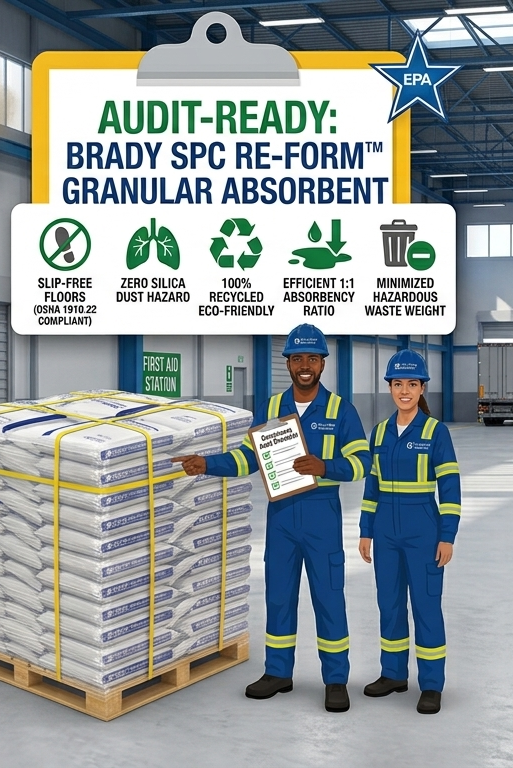
The Safety Manager’s Guide to Spill Compliance: Is Your Floor Dry Audit-Ready?
If you manage safety for an industrial facility, warehouse, or fleet maintenance shop, you know that keeping floors clean isn’t just about keeping the workspace looking good. It’s a matter of federal compliance.
When an inspector walks through your doors, slick floors, dusty air, and improperly managed spill supplies are instant red flags.
If you are still relying on traditional, dusty clay to clean up leaks and drips, you might be exposing your business to avoidable fines. Here is how upgrading to Brady SPC Re-Form™ Universal Granular Absorbent simplifies your spill control plan and keeps your facility fully audit-ready.
1. Slips, Trips, and Falls: Meeting OSHA 29 CFR 1910.22
Year after year, slips, trips, and falls rank near the top of OSHA’s most frequent workplace safety violations. Under OSHA 29 CFR 1910.22(a)(2), employers are legally required to maintain all floor surfaces in a clean, dry, and slip-free condition.
Traditional clay floor dry often leaves behind a slippery, muddy film when saturated with oils or water. If it isn't swept up perfectly, it can actually contribute to a slip hazard.
Re-Form Granular uses a highly thirsty, non-abrasive recycled paper fiber that pulls liquids completely out of the microscopic pores of concrete floors. It doesn't turn into mud or leave behind a slick residue, helping you maintain a truly dry, high-traction floor.
2. Eliminating the Crystalline Silica Hazard
Workplace health audits don't just look at the floor—they look at the air your team is breathing.
Standard clay floor dries contain crystalline silica. Every time a worker pours a bag, a fine cloud of white dust hangs in the air. Over time, inhaling this dust can lead to severe respiratory issues, making it a major concern during safety inspections.
-
Re-Form is 100% Recycled & Dust-Free: Because it is made from recycled paper waste, it releases virtually no airborne dust when applied.
-
Employee Safety: It contains no health hazards, requires no warning labels, and can be handled safely without wearing heavy respiratory gear just to clean up a simple puddle.
3. Streamlining Hazardous Waste Disposal (EPA 40 CFR 112.7)
Under environmental regulations like EPA 40 CFR 112.7, facilities must have clear plans and materials ready to prevent oil and chemical spills from spreading. But what happens after the spill is absorbed?
Because clay has a poor absorption ratio, you have to use a massive amount of it to clean up a spill. Since hazardous waste disposal is typically billed by weight, disposing of hundreds of pounds of heavy, oil-soaked clay gets incredibly expensive.
Re-Form features an efficient 1:1 absorbency ratio—absorbing its own weight in liquid.
-
You use significantly less product to clean up the exact same spill.
-
Your total volume of hazardous waste is dramatically reduced, keeping your storage areas clean and your waste-hauling invoices low.
Proactive Spill Prep: Don’t Wait for the Audit
The easiest way to pass a safety audit is to make compliance the easiest path for your workers. By replacing heavy, dusty clay with lightweight, high-efficiency Re-Form bags, your team can respond to spills faster, keep the air clean, and ensure floors are left completely dry.
We stock and drop-ship Brady SPC Re-Form Granular Absorbent in convenient bulk pallets of 65 bags (30 lbs each), giving you a massive 260-gallon total absorbency capacity to keep your facility fully stocked and compliant.
Recent Posts
-

Protection Meets Practicality: Forge FR P-MFRP-5 Brown Canvas Work Pants
When working in environments with flame and arc hazards, having safety gear that is both certified a …21st Oct 2026 -

Stanco FRC1512 vs. Forge FR MFRJ-104: Which FR Stretch Jeans Belong on Your Crew?
Choosing the right flame-resistant (FR) work jeans for your crew comes down to balancing arc flash p …21st Oct 2026 -

Why Electricians and Line Workers Are Switching to Stanco™ FRC1512 Memory Stretch Jeans
For electricians, utility technicians, and linemen, mobility isn't just about comfort—it's a fundame …16th Oct 2026