High-Performance Safety Workwear: Understanding Anti-Static Protection in Hazardous Environments
In modern industrial facilities, flame-resistant (FR) protective clothing is standard equipment. However, when working in environments where combustible dust, chemical vapors, or volatile gas mixtures are present, standard thermal protection alone isn't always enough. Electro-static discharge (ESD) presents a subtle, often invisible hazard capable of triggering ignition before workers ever encounter an external flame source.
Understanding how integrated anti-static protection works in flame-resistant apparel—and why international standards like EN 1149-5 and ATEX matter—is critical for safety directors, facility managers, and industrial crew members.
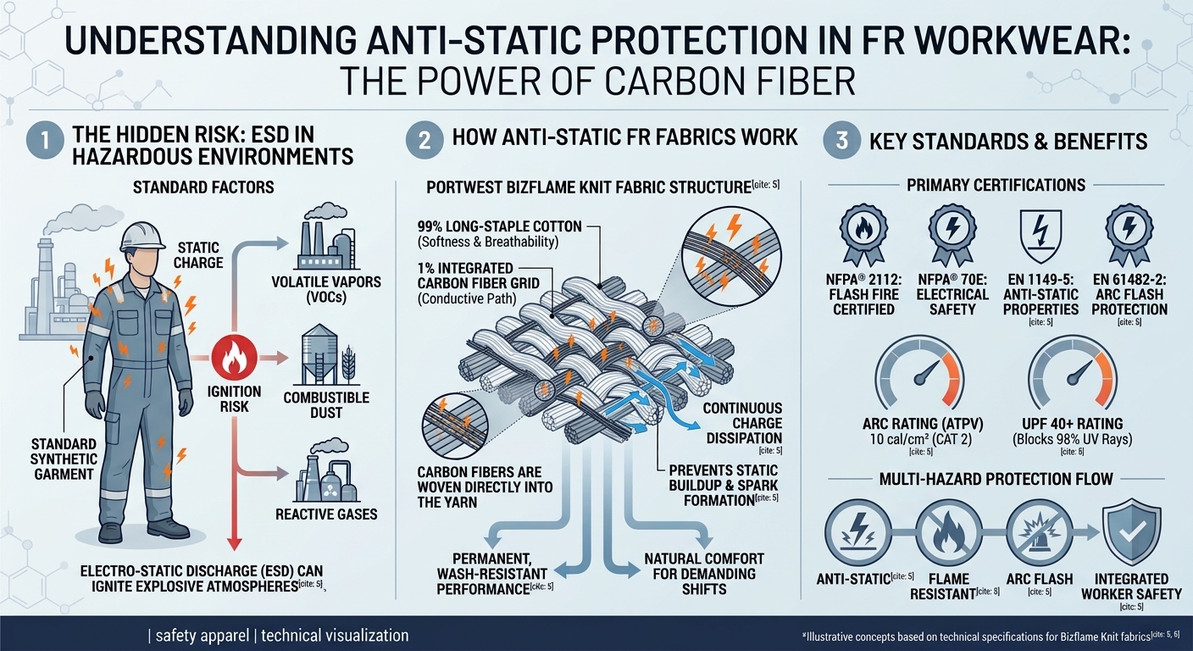
The Hidden Risk: Electro-Static Discharge (ESD)
Everyday body movements—such as walking across a surface, removing an outer layer, or sliding into a vehicle seat—generate static electricity. In typical environments, a minor static shock is nothing more than a nuisance. In high-risk industrial zones, however, a single static spark can deliver enough energy to ignite sensitive atmospheric fuel-air mixtures.
Hazardous environments where ESD poses an extreme risk include:
-
Petrochemical and Refining Operations: Where volatile organic compounds (VOCs) and fuel vapors accumulate.
-
Grain Handling & Food Processing Facilities: Where dense organic dust clouds create explosive atmospheres.
-
Chemical Manufacturing & Processing: Where solvent fumes and reactive chemical gases are present.
-
Electronics & Cleanroom Manufacturing: Where static discharge can destroy sensitive components or ignite volatile cleaning agents.
To prevent static accumulation, protective apparel must provide a continuous path for electrical charge dissipation across the fabric surface.
How Anti-Static FR Fabrics Work: The Power of Carbon Fiber
Traditional cotton and synthetic knits can build up significant electrostatic charges through friction. To neutralize this, advanced technical textiles blend high-performance conductive fibers directly into the yarn matrix during manufacturing.
In multi-hazard workwear—such as the Portwest Bizflame® Knit series (featured in styles like the FR32 Henley and FR33 Crew Neck)—the fabric structure pairs 99% premium long-staple cotton with 1% woven carbon fiber.
Why 1% Carbon Fiber Makes a Critical Difference:
-
Continuous Charge Dissipation: The integrated grid of carbon filaments safely drains static charges away from the body before a high-voltage spark can bridge an air gap.
-
Permanent Performance: Because the carbon fiber is spun directly into the core interlock knit rather than applied as a topical chemical treatment, the anti-static properties will not wash out, degrade, or wear off over the lifespan of the garment.
-
Breathable Natural Comfort: Maintaining a 99% cotton content preserves the soft hand-feel, high breathability, and natural moisture absorption necessary for long 12-hour shifts in hot or demanding environments.
Decoding Safety Standards: ATEX, EN 1149-5, and Multi-Hazard Compliance
When selecting workwear for static-sensitive zones, compliance markings provide the verification that garments have undergone rigorous standard testing.
-
EN 1149-5 (Electrostatic Properties): Specifies the material and design requirements for electrostatic dissipative protective clothing used as part of a total earthed system to avoid inflammatory discharges.
-
ATEX Directive Compliance: Ensures equipment and protective clothing are suitable for use in explosive atmospheres (Zones 0, 1, 2 for gases/vapors and Zones 20, 21, 22 for dust).
-
NFPA® 2112 & ASTM F1959: Certification standards confirming thermal flash fire protection and arc flash performance (CAT 2 / 10.0 cal/cm²).
Key Takeaway for Industrial Safety Programs
Safety compliance is about eliminating known risks before an incident occurs. Upgrading standard single-hazard FR gear to multi-hazard workwear equipped with built-in anti-static carbon fiber ensures your team remains protected against thermal flash fires, electric arc hazards, and electrostatic ignition sources simultaneously.
Whether outfitting crews in classic crew neck T-shirts or versatile 3-button Henleys, verifying that garments meet both NFPA 2112 and EN 1149-5 standards gives workers the comfort they want and the multi-layer protection the job demands.
Recent Posts
-
High-Performance Safety Workwear: Understanding Anti-Static Protection in Hazardous Environments
In modern industrial facilities, flame-resistant (FR) protective clothing is standard equipment. How …30th Oct 2026 -
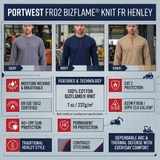
Classic Henley Style Meets CAT 2 Defense: The Portwest FR02 Bizflame® Knit FR Shirt
Finding workwear that balances everyday job site styling with certified arc flash and flame protecti …28th Oct 2026 -
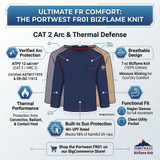
Ultimate Flame-Resistant Comfort: The Portwest FR01 Bizflame® Knit Crew Neck Shirt
For tradesmen and safety personnel working in environments with potential electric arc, convective, …26th Oct 2026