Blog
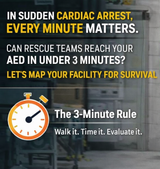
The Race Against the Clock: Why One AED Is Rarely Enough
In the world of Sudden Cardiac Arrest (SCA), time isn't just money—it’s life. For every minute that passes without a shock from a defibrillator, the chance of survival drops by approximately 7% to 10%.
At Your Safety Company, we don't just sell equipment; we help you map out a survival strategy. If your AED is tucked away in a distant front office, it might as well be in another building when an emergency happens on the loading dock.
1. The 3-Minute Rule
The national standard for AED
…
26th Mar 2026
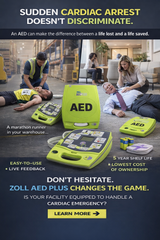
The Science of the Save: Why the ZOLL AED Plus is Different
Sudden Cardiac Arrest doesn't discriminate. It can happen to a marathon runner in your warehouse or a long-time client in your lobby. In those first few minutes, the difference between a tragic outcome and a life saved is the presence of an AED.
However, many people hesitate to use an AED because they fear doing it wrong. This is where the ZOLL AED Plus changes the game.
1. Real CPR Help®: A Coach in the Room
Most AEDs tell you to "Push Harder," but the ZOLL AED Plus actually knows if you ar
…
25th Mar 2026
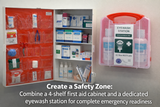
The "Safety Zone": Coordinating Your First Aid Cabinet and Eyewash Station
In a high-functioning facility, safety equipment shouldn't be scattered at random. Instead, smart managers create "Safety Zones"—strategic locations where a worker can find both a 4-shelf first aid cabinet for traumatic injuries and a dedicated eyewash station for chemical exposures.
At Your Safety Company, we help you coordinate these two essential hubs to ensure your team has the right response for the right emergency.
1. The 4-Shelf Cabinet: Your Central Inventory Hub
Think of the 4-she
…
24th Mar 2026
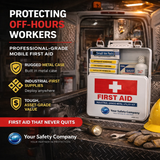
Built for the Bumps: Why Your Fleet Needs the Metal Utility Kit
For many facilities, Monday morning begins with a flurry of activity—and sometimes, a flurry of minor injury reports from the skeleton crew that worked through the weekend. While your main, wall-mounted 4-shelf central hub is locked up in the main office or the breakroom is closed, your maintenance teams, security guards, and delivery drivers are still active.
At Your Safety Company, we believe that professional-grade first aid should never be "off-duty." That is why we recommend equipping
…
23rd Mar 2026
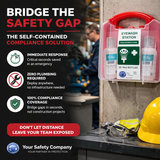
Bridge the Safety Gap: The Self-Contained Compliance Solution
On a typical Friday walkthrough, you might notice something: a small workstation, a specialized mixing area, or a remote maintenance bay that seems just out of reach of your main safety stations.
At Your Safety Company, we know that achieving 100% compliance across a complex facility is a constant challenge. That is why we designed our Personal Eyewash Units—the self-contained, secondary solution to bridge those critical safety gaps without requiring major infrastructure changes.
The Real
…
20th Mar 2026