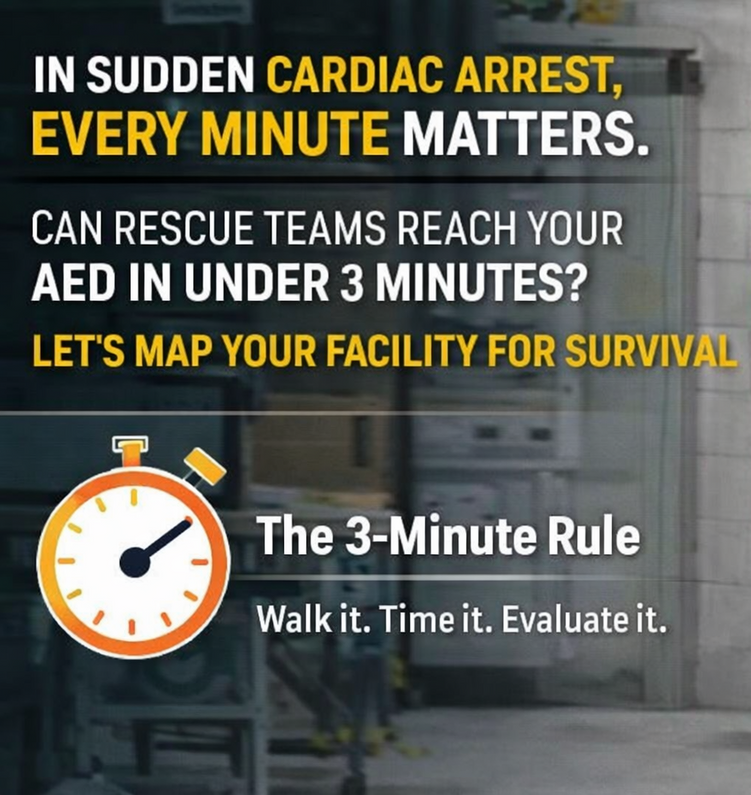
The Race Against the Clock: Why One AED Is Rarely Enough
In the world of Sudden Cardiac Arrest (SCA), time isn't just money—it’s life. For every minute that passes without a shock from a defibrillator, the chance of survival drops by approximately 7% to 10%.
At Your Safety Company, we don't just sell equipment; we help you map out a survival strategy. If your AED is tucked away in a distant front office, it might as well be in another building when an emergency happens on the loading dock.
1. The 3-Minute Rule
The national standard for AED placement is designed around a 3-minute "drop-to-shock" goal.
-
The Math of Survival: This means a responder has 90 seconds to reach the AED and 90 seconds to return to the victim and apply the pads.
-
The Reality Check: Walk from your furthest workstation to your current AED at a brisk pace. If it takes you longer than 90 seconds to get there, your facility has a dangerous safety gap.
2. Obstacles You Can't See on a Map
When calculating how many AEDs you need, you have to account for "industrial friction."
-
Vertical Distance: Elevators and stairs can double your response time. We recommend at least one AED per floor in multi-story buildings.
-
Locked Doors: If a worker has to find a supervisor with a key or badge into a restricted area to reach the AED, the "3-minute window" will slam shut before they return.
-
The "Panic Factor": In a crisis, people don't run in straight lines. They hesitate and search. Placing AEDs in high-visibility "Safety Zones" near your 4-shelf cabinets reduces this search time.
3. Scaling Your Protection
Just as we use 2-shelf satellite cabinets to bridge the gap between main hubs, you should use multiple AEDs to cover high-risk or remote areas.
-
High-Risk Zones: Areas with high physical exertion, extreme temperatures, or high-voltage equipment should have a dedicated device.
-
The ZOLL Advantage: By choosing a device like the ZOLL AED Plus, which features a 5-year battery and pad life, you can scale your fleet of AEDs without creating a massive maintenance burden for your safety manager.
4. Visual Readiness
An AED only saves a life if it can be found.
-
Consistent Placement: Mount your AEDs in consistent, high-visibility locations, ideally next to your Personal Eyewash Units and first aid stations.
This Week’s Survival Challenge:
Put a stopwatch on a volunteer today. Have them "respond" from your furthest machine to your AED. If the total round-trip time is over 3 minutes, it’s time to add a second unit.
Don't let a "Long Walk" be the reason a life is lost. Let Your Safety Company help you map your facility for survival.
Recent Posts
-
The Race Against the Clock: Why One AED Is Rarely Enough
In the world of Sudden Cardiac Arrest (SCA), time isn't just money—it’s life. For every minute that …26th Mar 2026 -
The Science of the Save: Why the ZOLL AED Plus is Different
Sudden Cardiac Arrest doesn't discriminate. It can happen to a marathon runner in your warehouse or …25th Mar 2026 -
The "Safety Zone": Coordinating Your First Aid Cabinet and Eyewash Station
In a high-functioning facility, safety equipment shouldn't be scattered at random. Instead, smart ma …24th Mar 2026