
The High Price of "Cheap" Protection: Why Task-Specific Gloves Save Your Bottom Line
For many procurement managers, a glove is just a glove. The temptation is often to buy the lowest-cost option in bulk and distribute it across the entire facility. However, a "one-size-fits-all" purchasing strategy is often one of the most expensive mistakes a facility can make.
In 2026, efficiency is about matching the tool to the task. Here is why task-specific glove selection is a financial strategy, not just a safety requirement.
1. Reducing the "Double-Gloving" Tax
When a worker is given a 3 mil glove for a task that involves light mechanical work or abrasive surfaces, the glove will likely tear within minutes. To compensate, workers often "double-glove"—wearing two layers to feel secure.
-
The Cost: You are now paying for two gloves to do the job of one.
-
The Solution: Moving those workers to a 4 mil (GL-N135F) or a 5.5 mil (GL-N106F) ensures the glove lasts the entire task, cutting your consumption rate in half.
2. Eliminating "Dexterity Downtime"
The opposite is also true. If a technician performing high-precision assembly is forced to use a thick, bulky glove, their task takes longer. They lose tactile sensitivity, leading to dropped parts, slow production, and hand fatigue.
-
The Cost: Lost labor hours and potential quality control errors.
-
The Solution: A high-sensitivity 3 mil medical-grade glove (GL-N103EPF) provides the "second-skin" feel needed to keep production speeds high and errors low.
3. Preventing Cross-Contamination & Recalls
In food processing or clinical environments, using a glove not rated for the specific chemicals or materials in use can lead to barrier failure.
-
The Cost: A single batch contamination or a safety violation can cost more than a year’s supply of premium gloves.
-
The Solution: Using gloves that are specifically FDA 21 CFR 177 compliant and ASTM D6319 rated ensures that you aren't just wearing a blue glove—you're wearing a certified barrier.
The Bottom Line: Audit Your Environment
Don’t let "price per box" blind you to "cost per task." By auditing your facility and providing a 3 mil glove for the lab, a 4 mil glove for the kitchen, and a 6 mil glove for the maintenance bay, you reduce waste, improve morale, and protect your budget.
Ready to stop wasting your PPE budget? We help facilities map their tasks to the right products. Let’s look at your high-usage areas and find a better fit.
Recent Posts
-

The High Price of "Cheap" Protection: Why Task-Specific Gloves Save Your Bottom Line
For many procurement managers, a glove is just a glove. The temptation is often to buy the lowest-co …16th Feb 2026 -
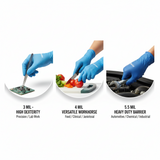
Beyond "One Size Fits All": Matching Glove Mil-Thickness to Your Specific Task
In many facilities, the "standard blue nitrile glove" is treated like a commodity—ordered in bulk an …13th Feb 2026 -
The Heart of Your Facility: Is Your Team Prepared for a Cardiac Emergency?
February is American Heart Month, a time typically focused on diet and exercise. But for facility ma …12th Feb 2026