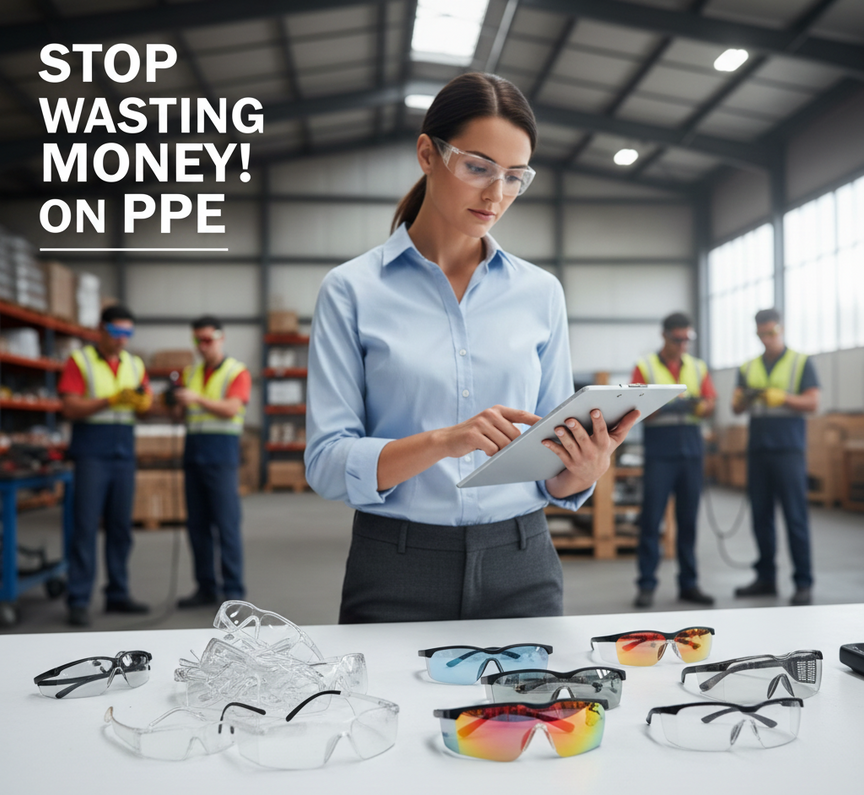
Stop Wasting Money on PPE: 3 Ways Safety Managers Can Optimize Eyewear Selection
Introduction
Safety is never the place to cut corners, yet inefficient spending on Personal Protective Equipment (PPE) is a common drain on industrial budgets. For safety managers, the challenge is clear: how do you procure high-quality, high-compliance eyewear without constantly replacing cheap, broken, or unused units?
The answer lies in moving beyond the "one-size-fits-all" bulk purchase and adopting a Feature-Matched strategy. Here are three crucial steps to optimize your eyewear program, save money long-term, and, most importantly, increase compliance.
1. Match Technology to the Hazard (Stop Over- and Under-Buying)
The biggest mistake is either buying basic clear lenses for every task or buying premium lenses for everyone. The true cost savings come from selecting the correct specialized lens for the specific hazard.
| Hazard/Environment | The Expensive Mistake | The Optimized Solution |
| High Heat / Brazing | Using standard shaded safety glasses. | IR Filter Lenses (Shade 3.0 or 5.0). Example: PIP Anser™ IR Filter |
| High Humidity / Respiration | Buying standard anti-scratch lenses. | Anti-Fog Coatings (Hydrophobic or Hydrophilic). Example: Site Boss FogLess® 3Sixty™ |
| Severe Outdoor Glare | Relying on cheap tinted lenses that cause eye strain. | Polarized Lenses (e.g., Fire Mirror Plus PRO Polarized). Eliminates harsh glare from reflective surfaces like water or metal. |
By precisely matching a worker's environment to a specialized coating, you extend the usable life of the eyewear and ensure workers have the best tool for the job.
2. Prioritize Comfort to Eliminate the "Take-Off Tax"
The most compliant safety glasses are the ones that workers actually keep on their face. Cheap eyewear often lacks basic ergonomic features, leading workers to take them off in frustration—resulting in both non-compliance fines and higher injury risk. We call this the "Take-Off Tax."
Look for comfort features that encourage wear:
-
Flexible Temples: Features like AirFlex™ Temples conform to different head sizes, providing a secure, non-binding grip that lasts all shift.
-
Adjustable Nosepieces: Soft, adjustable rubber nose pads distribute weight evenly, reducing pressure points that cause headaches.
-
Lightweight Design: Frameless or semi-rimless options, like the Site Boss Enhanced Coverage Frameless line, are significantly lighter than traditional full-frame spectacles.
3. Focus on Durability to Reduce Replacement Cycling
While a unit of basic safety glasses might be cheap initially, if you replace them every month due to breakage or scratches, the true cost skyrockets.
Recent Posts
-
Why Tap Water Isn't Enough: The Science of Professional Eye Relief
In an emergency, the instinct is to grab the nearest liquid to flush an eye. While any water is bett …4th Mar 2026 -
Clean, Portable, and Ready: Why the Dust Cover is a Safety Game-Changer
In an industrial environment, the biggest enemy of your safety equipment isn't just time—it’s the en …3rd Mar 2026 -
The Eyewash Station: Your First Line of Defense in an Eye Emergency
In any workplace, safety should always be a top priority. When it comes to eye safety, every second …2nd Mar 2026