Frameless vs. Full-Frame: Which Safety Glasses Design is Right for You?
When choosing safety eyewear, the lens color and coating are critical, but the frame design itself plays a huge role in comfort, field of vision, and overall user experience. Should you opt for sleek, minimalist frameless glasses or the robust, classic feel of a full-frame pair? Let's break down the advantages of each to help you make the best choice for your work.
The Appeal of Frameless Safety Glasses
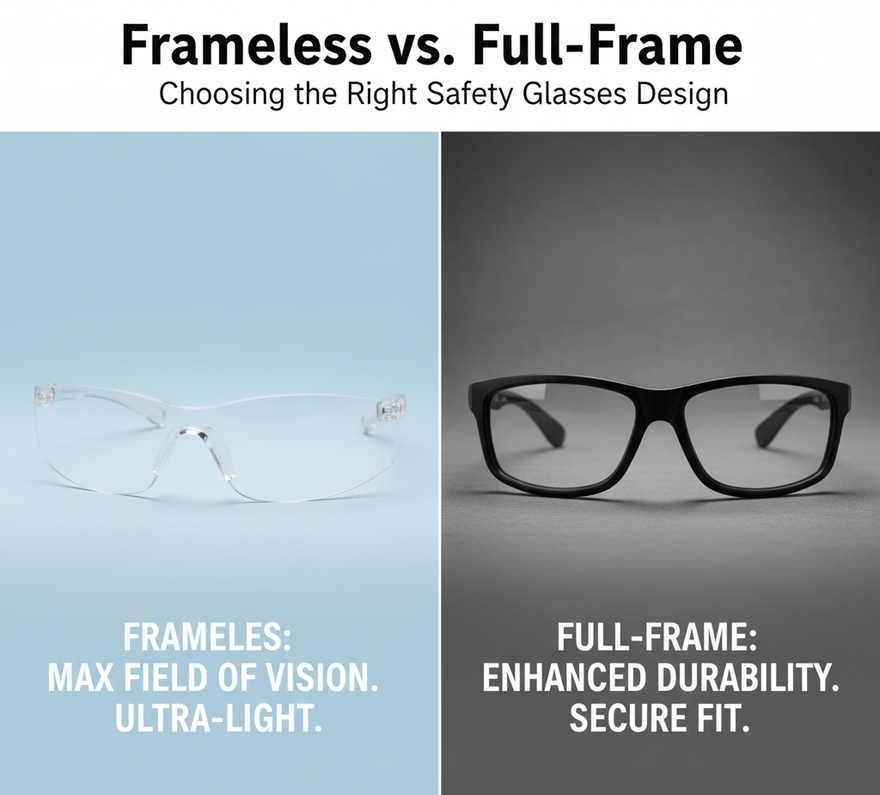
Frameless safety glasses feature a single, uninterrupted lens that extends across the entire field of vision. This design offers several compelling benefits:
-
Unobstructed Field of View: Without a frame blocking your peripheral vision, you get a wider, clearer perspective. This is incredibly valuable in dynamic environments where situational awareness is key.
-
Lightweight Comfort: By eliminating the frame material, frameless glasses are typically much lighter. Models like the Carhartt Billings® and PIP Recon™ weigh as little as 26 grams, reducing pressure points and making them ideal for all-day wear.
-
Modern Aesthetics: Their sleek, minimalist look is often preferred by those who want their safety eyewear to feel less industrial and more like regular glasses.
-
Reduced Fogging: With less frame material to trap heat, frameless designs can sometimes offer better airflow, which can contribute to reducing fog buildup, especially when combined with advanced coatings like FogLess® 3Sixty™.
Best for: Tasks requiring maximum peripheral vision, extended wear, or those who prefer a less obtrusive feel.
The Robustness of Full-Frame Safety Glasses
Full-frame safety glasses enclose the lens entirely within a sturdy frame. This traditional design has its own set of distinct advantages:
-
Enhanced Durability: The frame provides an extra layer of protection around the lens edges, potentially increasing the overall lifespan of the glasses in rugged conditions.
-
Stronger Grip/Fit: Full frames often allow for more substantial temple arms and nose bridges, which can provide a very secure, immovable fit, essential for high-movement tasks. Many models, like the Pyramex Furix®, feature co-injected temples and adjustable nose pieces for superior grip.
-
Wider Range of Styles: Full frames offer more opportunities for design variations, colors, and features, providing a broader aesthetic appeal and personal customization.
-
Prescription Compatibility: Many full-frame models are more easily adaptable for prescription inserts or integrated prescription lenses.
Best for: Demanding environments where maximum frame durability is a concern, or for those who prefer a traditional, secure-fitting eyewear style.
Making Your Decision
The choice between frameless and full-frame often comes down to personal preference, the specific demands of your job, and the level of comfort you require for extended wear.
-
Consider your environment: Do you need maximum peripheral vision, or do you work in conditions where frame durability is paramount?
-
Think about comfort: Are you wearing them all day? Lightweight frameless might be better.
-
Don't compromise on standards: Regardless of design, always ensure your safety glasses meet ANSI Z87.1 (and CSA Z94.3 in Canada) high-impact standards.
Both frameless and full-frame options offer excellent protection when chosen correctly. Evaluate your needs, explore the options, and find the perfect pair to keep your eyes safe on the job.
Recent Posts
-
The Eyewash Station: Your First Line of Defense in an Eye Emergency
In any workplace, safety should always be a top priority. When it comes to eye safety, every second …2nd Mar 2026 -
The Unsung Hero of Consistency: Why Your Team Trusts the Same Safety Supplies
Imagine trying to bake a cake with a different brand of flour, sugar, and eggs every time. The resul …27th Feb 2026 -
The Hidden Cost of "The Walk": Why Accessible Safety Supplies Matter
In a busy facility, time isn’t just money—it’s momentum. One of the most common "hidden costs" in pr …26th Feb 2026