Beyond the Breeze: Is Your Facility Ready for the 2026 OSHA Heat Push?
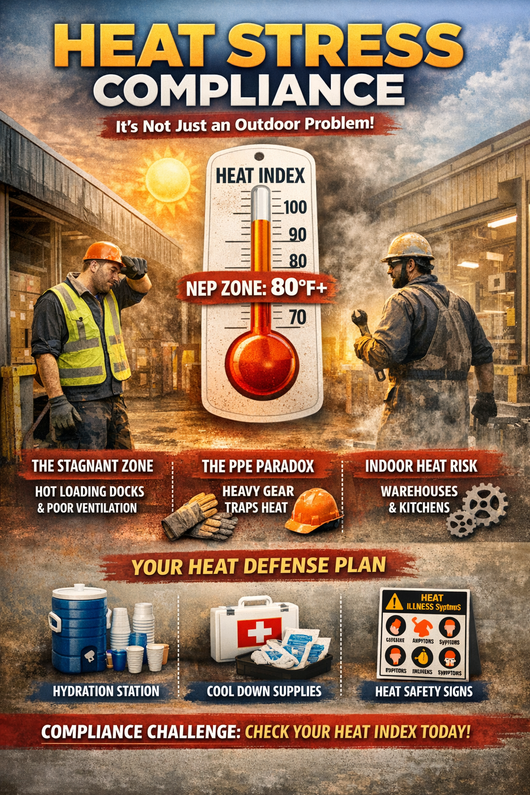
As we close out March, the "Spring Cleaning" list usually focuses on dust and organization. But this year, there is a much higher-stakes item on the checklist: Heat Stress Compliance. OSHA’s National Emphasis Program (NEP) on Heat is in full swing, and inspectors are currently authorized to evaluate heat-related hazards during any site visit. Whether your team is outdoors on a loading dock or indoors near heavy machinery, "waiting for summer" to address heat is a major compliance risk.
The Indoor Heat Myth
Many managers believe heat stress is an "outdoor-only" problem. However, OSHA’s 2026 focus explicitly targets indoor environments like warehouses, kitchens, and mechanical rooms where airflow is limited.
-
The Stagnant Zone: Even in March, a sun-drenched loading dock or a poorly ventilated mezzanine can reach a heat index that triggers OSHA’s "General Duty" requirements.
-
The PPE Paradox: As we move into spring, workers wearing heavy-duty gear or nitrile gloves generate more metabolic heat. Without a plan, your safety gear could actually contribute to heat exhaustion.
The "Your Safety Company" Heat Defense Plan
Staying compliant isn't about expensive HVAC overhauls; it's about the "Water, Rest, Shade" fundamentals supported by the right equipment:
-
Hydration as a Standard: OSHA requires that cool, potable water be accessible near the work area. We recommend moving beyond the "community cooler" and ensuring your 4-shelf Hub and 2-shelf Satellite stations include electrolyte replacements to supplement water intake.
-
The Acclimatization Window: OSHA is looking for a written plan for new or returning employees. Their bodies need 7 to 14 days to adjust to rising temperatures. Our Metal Utility Kits should be stocked with instant cold packs to provide immediate relief if a worker shows early signs of heat fatigue during this window.
-
Visual Cues for First Responders: Heatstroke is a medical emergency. Just as our Personal Eyewash Units use clear icons, your heat plan should include visible signage near your Safety Zones that helps employees recognize the "buddy system" signs: dizziness, irritability, and heavy sweating.
This Week’s Compliance Challenge:
Take a thermometer to your three warmest indoor workstations today. If the heat index is over 80°F, you are officially in the "NEP Zone." Don't wait for an inspection to find a gap in your climate safety.
Recent Posts
-
Beyond the Breeze: Is Your Facility Ready for the 2026 OSHA Heat Push?
As we close out March, the "Spring Cleaning" list usually focuses on dust and organization. But this …2nd Apr 2026 -

The Race Against the Clock: Why One AED Is Rarely Enough
In the world of Sudden Cardiac Arrest (SCA), time isn't just money—it’s life. For every minute that …26th Mar 2026 -

The Science of the Save: Why the ZOLL AED Plus is Different
Sudden Cardiac Arrest doesn't discriminate. It can happen to a marathon runner in your warehouse or …25th Mar 2026